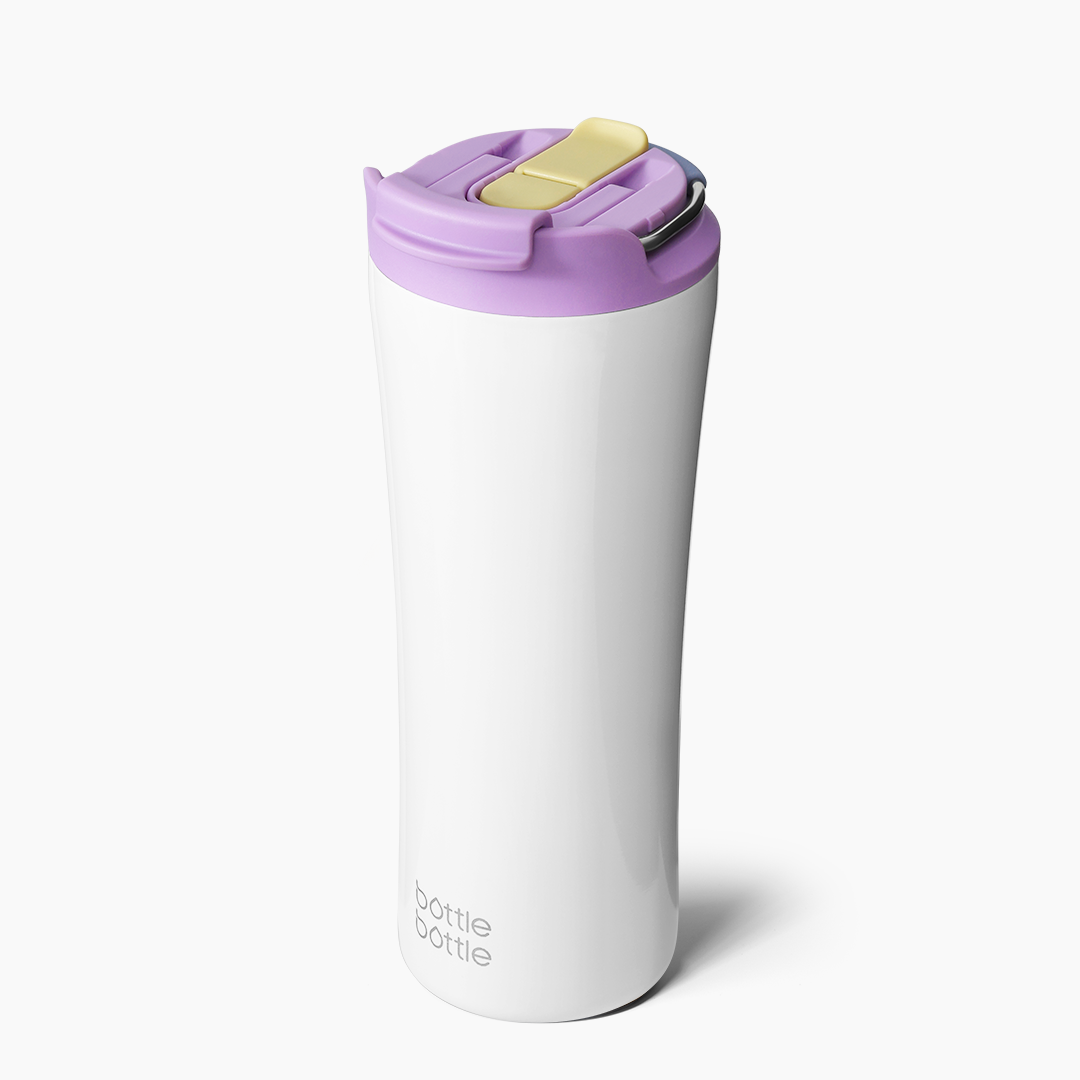
They all hold cold water, so why are there three shapes? Because they solve different problems. Grab the wrong one and you'll be annoyed every time you use it. Here's how the three actually differ once you live with them.
What's a bottle really good at?
A bottle has a narrow-ish neck and a sealed lid, so it survives being tossed in a bag sideways. That's the whole point. It's the only one of the three you can throw in a backpack without a towel underneath.
Insulated stainless bottles in the 20-32oz range are the everyday workhorse. Expect $22 to $32. If you move around a lot during the day, a bottle is almost always the answer.
When is a tumbler the smarter pick?
A tumbler is built for a surface. It's wider at the base, usually has a straw or a sip lid, and it's shaped to sit in a cup holder or on a desk. The trade is that most tumblers aren't fully leakproof. Tip one over in your bag and you'll find out.
Tumblers shine at a desk, in the car, or on the couch. The straw means you sip more without thinking, which is honestly why a lot of people drink more water with one. Prices run $25 to $35 for a good double-wall version.
Who it's not for: commuters who cram everything into one bag, and anyone who bikes or hikes. A sloshing, semi-open tumbler is the wrong tool for motion.
What's a jug for?
A jug is the big one, usually 64oz or more, with a handle. It's not something you carry around all day. It parks on your desk, in the gym, or in the car cup holder if it fits, and you drink from it in one place.
The appeal is simple: fill once, done for hours. If your goal is hitting a hydration number and you hate refilling, a jug removes the excuse. But it's heavy and awkward, and nobody's slipping a 64oz jug into a purse.
A rough decision tree
- You're moving all day and bag it: bottle
- You mostly sit at a desk or in a car: tumbler
- You want to fill once and forget it: jug
Can one of them do everything?
Not really, and that's fine. A 24oz bottle is the closest to an all-rounder, but it won't beat a tumbler for lazy desk sipping or a jug for sheer volume. Most people who care about this end up with two: a bottle for the go-bag and a tumbler or jug for their main spot.
Lids change the whole equation
Worth flagging before you commit: the lid matters as much as the shape. A bottle with a straw lid behaves a little like a tumbler. A tumbler with a screw-on leakproof cap behaves a little like a bottle. Don't over-think the category name. Think about how you'll actually drink and where the thing will spend its day.
How does cleaning differ between the three?
This never makes the marketing copy, but it should shape your choice. Bottles with a narrow neck need a bottle brush to reach the bottom. Tumblers are wide enough to get a hand and sponge inside, which is genuinely easier. Straws in either one need a skinny straw brush, and if you skip it, you'll regret it in about two weeks.
Jugs are usually wide-mouthed and easy to scrub, but they're big and awkward in a crowded sink. If you're the type who won't hand-wash, check that the lid and body are top-rack dishwasher-safe before you buy anything.
What do they cost to run?
Upfront prices overlap more than you'd expect. A solid bottle is $22 to $32, a good tumbler $25 to $35, and a basic jug $20 to $30 since it's mostly just volume with fewer fancy parts. The ongoing cost is replacement straws and gaskets, roughly $6 to $12 a year if you use a straw lid daily. Plain lids cost you nothing after purchase, which is a quiet point in the bottle's favor.
If you can only buy one, start with the bottle. It handles the most situations without embarrassing you in any of them. Add the specialist later once you know your habits.