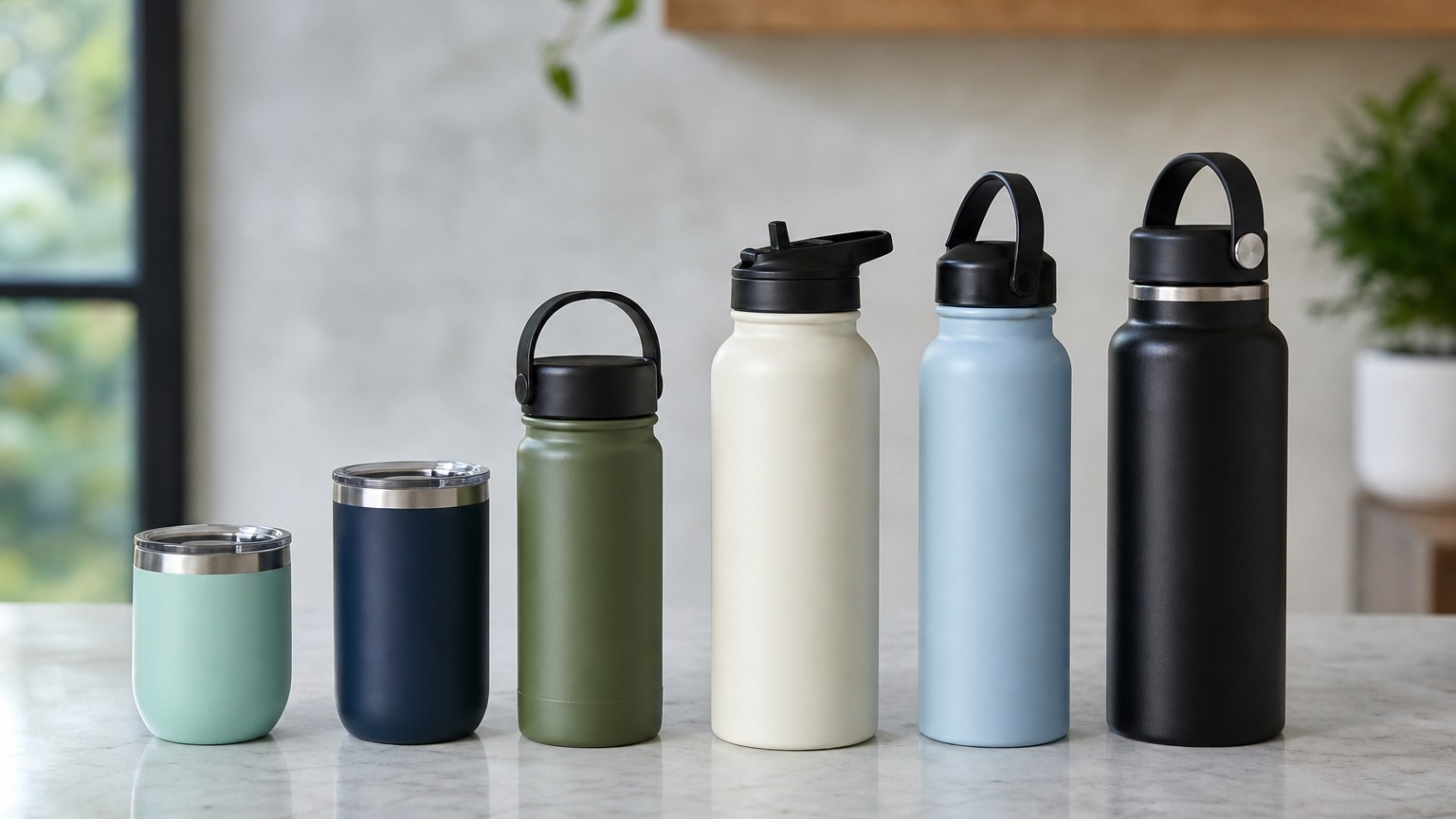
Shopping for a bottle gets confusing fast when one brand lists sizes in ounces and another uses milliliters or liters. The two systems describe the same thing, but flipping between them in your head is a hassle. A little familiarity with the common conversions makes comparing bottles across brands effortless.
The one number to remember
One US fluid ounce is about 29.6 milliliters, which for practical purposes you can round to 30. That single approximation lets you convert any bottle in your head: multiply ounces by 30 to get roughly the milliliters, or divide milliliters by 30 to get ounces. It will be off by a percent or two, which never matters when picking a water bottle.
Common sizes side by side
- 12 oz: about 355 ml, a small bottle for kids or short trips.
- 16 oz: about 475 ml, a compact everyday size.
- 18 oz: about 530 ml, a common purse-friendly size.
- 24 oz: about 710 ml, the popular all-day adult size.
- 32 oz: about 950 ml, nearly a full liter, good for the office or gym.
- 40 oz: about 1,180 ml, a large bottle for hikes and hot days.
- 64 oz: about 1,890 ml, a jug-sized bottle for serious hydration goals.
Where the liter fits in
Milliliters roll up into liters, with 1,000 ml making one liter. So a 32 oz bottle is close to one liter, a handy anchor point. If your daily water target is two to three liters, that maps to roughly two or three 32 oz bottles, or three to four 24 oz refills. Thinking in liters can make daily goals easier to track than counting ounces.
Watch for US versus imperial ounces
There is a small trap worth knowing. The US fluid ounce and the UK imperial fluid ounce are slightly different sizes, and a US pint is 16 oz while a UK pint is 20 oz. For water bottles sold in North America you will almost always see US ounces, so the 30 ml rule of thumb holds. Just be aware if you are comparing products from different regions.
Why the conversion helps you shop
Estimating your daily intake in either unit
Size conversions become genuinely useful when you map them to daily goals. If your target is around two to three liters of water a day, that is roughly 68 to 100 US ounces. Picture it in bottles: three refills of a 24 oz bottle lands near 72 oz, while two fills of a 32 oz bottle reaches 64 oz and a third gets you comfortably past 90. Thinking this way turns an abstract number into a concrete plan for the day. Whether your bottle is labeled in ounces or milliliters, knowing how many refills add up to your goal removes the guesswork and helps you choose a capacity that matches how often you actually want to refill.
One caution worth keeping in mind: not every bottle is filled precisely to its stated capacity, and the usable volume is always a little less than the total once you account for the space the lid and any straw take up. Treat the printed number as a close approximation rather than an exact measure. For choosing a bottle it makes no practical difference, but if you are carefully tracking intake, fill the bottle and note where the water actually sits rather than trusting the label to the last milliliter.
When you can instantly translate 750 ml into roughly 25 oz, or 1 liter into about 34 oz, you stop being anchored to one brand's labeling and can compare capacity honestly across the whole market. That clarity helps you avoid buying a bottle that turns out smaller or larger than you pictured. Keep the multiply-by-30 trick in mind and no size label will trip you up again.