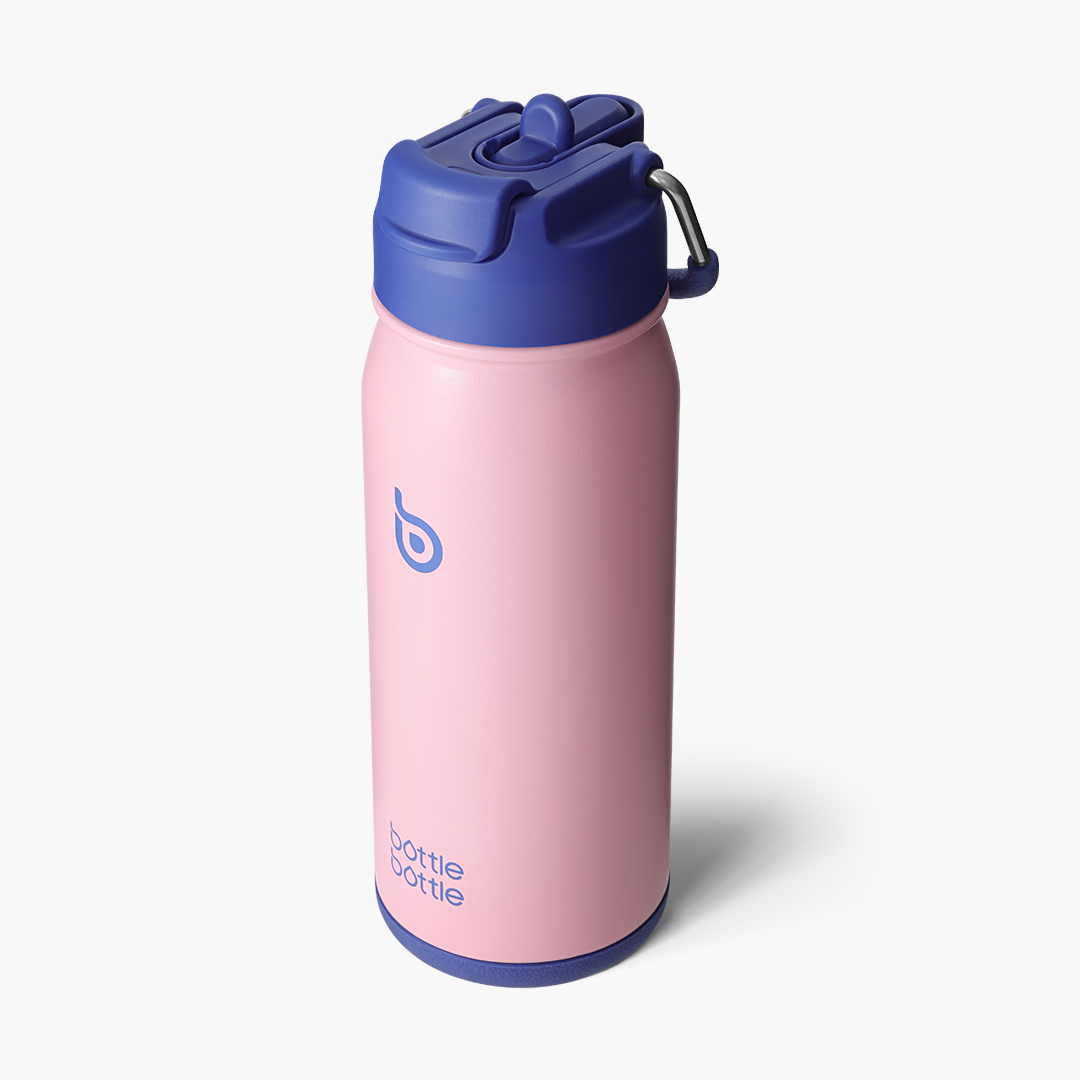
Pour ice water into a cheap plastic bottle and leave it on your desk. Within an hour the outside is dripping and the water's gone lukewarm. Do the same with a double-wall vacuum bottle and you can come back six hours later to ice still rattling around. Same room, same water. The difference is almost entirely about one thin gap you can't see.
What's happening inside the wall?
A vacuum-insulated bottle is really two bottles, one nested inside the other, welded together at the neck. Between them is a sealed cavity with almost all the air pumped out. That near-empty space is the whole trick.
Heat moves three ways: conduction, convection, and radiation. Conduction needs something solid or dense to travel through, metal, water, air. Convection needs a fluid that can circulate and carry warmth around. Pull the air out of that cavity and you've knocked out most of the pathway for both. There's barely anything left to carry heat from the warm room into your cold water, or the other direction when you've got tea in there.
So why isn't it perfect?
Radiation still sneaks through. Warmth crosses empty space as infrared, which is why the sun heats you through the vacuum of space. Manufacturers fight this by coating the inner wall with a reflective copper or silver layer, sometimes called "copper plating" on the spec sheet. It bounces radiant heat back instead of letting it soak in. A bottle with that reflective layer will usually hold cold several hours longer than one without, even when the steel and shape look identical.
The other leak is the neck. The two walls have to join somewhere, and metal at that seam conducts heat straight through, bypassing the vacuum. It's a small area, but it's why the top inch of your drink warms faster than the bottom, and why a wide-mouth bottle with a big opening loses cold a little quicker than a narrow sports cap.
Single wall vs double wall
A single-wall stainless bottle, the kind you sometimes see marketed as lightweight, has no vacuum gap at all. It'll sweat, it'll go warm fast, and if you fill it with hot coffee the outside gets too hot to hold. Those bottles have their place, they're cheaper and lighter, but don't buy one expecting temperature performance. If a listing doesn't say "double wall" or "vacuum insulated" anywhere, assume it's single wall.
- Single wall: light, cheap, sweats, no real insulation
- Double wall (no vacuum): a bit better, still disappointing
- Double wall vacuum: the real thing, holds temperature for hours
How they build the vacuum
During manufacturing there's a small port, often on the bottom, where the air gets drawn out with a pump. Then it's sealed, sometimes with a tiny solder plug you can feel if you run a finger over the base. Some designs drop in a "getter," a pinch of reactive material that absorbs the last stray gas molecules over time and keeps the vacuum tight for years.
That seal is also the failure point. Drop a bottle hard enough on concrete and you can crack the weld or dent the inner wall into the outer one. Once air gets back into the cavity, the insulation is basically dead. The bottle won't leak your drink, it'll just stop keeping it cold, and there's no fixing it. A bottle that suddenly sweats or goes warm fast after a bad fall has almost certainly lost its vacuum.
Does the vacuum wear out on its own?
A well-made bottle should hold its vacuum for a decade or more with normal use. Cheap ones with a weak seal can slowly fail over a year or two, you'll notice the cold-retention time creeping shorter. It's one of the quiet reasons a $12 no-name bottle and a $28 bottle can look the same on day one and feel very different by month eight.
What actually affects your real-world results
Marketing loves to promise "24 hours cold," and under lab conditions, sealed, full of ice, sitting still in a cool room, that can be true. Your kitchen counter in July is not a lab. A few things move the needle:
- Pre-chill the bottle before you fill it, a warm bottle steals cold from your first pour
- Fill it most of the way, a half-empty bottle has more warm air inside working against you
- Keep the lid on, every sip lets warm air in and cold air out
- Direct sun and a hot car will beat any bottle eventually
Understanding the vacuum won't change how your bottle performs, but it does explain the price gaps, the marketing claims, and why that dented one from last summer stopped working. When you know the cold is being held by a thin sealed void with a reflective lining, the whole thing feels a little less like magic and a lot more like something worth taking care of.